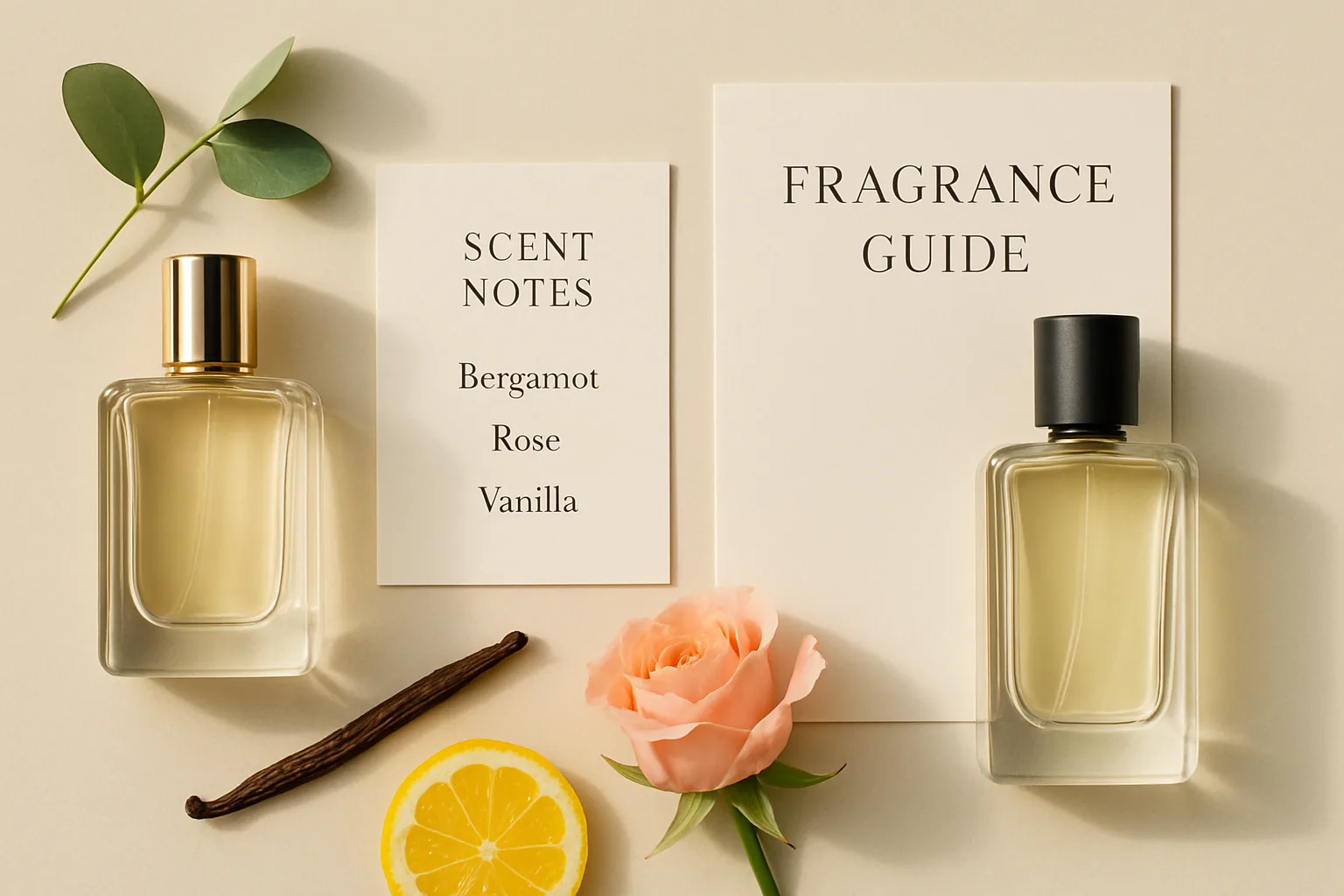
You do not need to identify every ingredient to describe a perfume well. Begin with broad impressions: is it bright or dark, airy or dense, dry or sweet? Then consider texture. A fragrance might feel smooth, crisp, powdery, creamy, smoky, or green. These words communicate how it comes across without claiming to know its exact formula.
Next, notice how the scent develops. What do you smell at first? Which details remain after the opening fades? A perfume may begin with a tart, sparkling impression and become softer and woody, or open with a floral note that gradually blends into musk. You can describe these changes without treating them as a precise list of ingredients.
It also helps to separate observation from preference. “I notice a sweet vanilla-like quality” is different from “I enjoy the sweetness.” Both are useful, especially when keeping sampling notes or discussing fragrance with someone else. Compare only a few perfumes at a time, and use your own familiar references, such as fresh herbs, paper, or fruit peel. Clear personal language is more valuable than technical terms used without confidence.
Building a Vocabulary That Grows With You
Once you are comfortable with broad impressions and texture, the next step is to give your descriptions more shape. A useful habit is to think in three layers: character, performance and context. Character is what the scent smells like. Performance is how it behaves on your skin over time. Context is where and when it seems to belong. Covering all three gives a fuller picture than a single adjective ever could.
Describing performance honestly
Performance is usually discussed in terms of projection, meaning how far the scent reaches from your skin, and longevity, meaning how long you can still notice it. Both vary with skin, climate, the amount applied and the concentration of the fragrance, so describe what you actually observed rather than making sweeping claims. "After about an hour it sat close to the skin" is more helpful than "it doesn't last." If you are curious why two versions of the same perfume behave differently, our guide to eau de parfum versus eau de toilette explains the basics.
Borrowing from other senses
Smell has a limited vocabulary of its own, so most people borrow words from sight, touch, sound and taste. A scent can feel "loud" or "quiet," "warm" or "cool," "sharp" or "rounded." Colour words work well too: a fragrance might seem golden, silvery or deep green. These comparisons are not scientific, but they tend to be understood intuitively and can describe mood in a way ingredient names cannot.
Using fragrance families as a starting point
Placing a perfume roughly within a family, such as citrus, floral, woody, amber or fougère, gives the listener a quick anchor before you add detail. You might say a scent is "a soft woody fragrance with a slightly peppery edge." If the categories are new to you, the beginner's guide to fragrance families offers an overview, and learning how to read a perfume's notes will help you compare your impressions with the official description.
Keeping a simple record
Writing a few lines for each perfume you try quickly builds a personal reference library. Note the date, the conditions, your first impression, how it changed and how you felt about it. Over time you will spot patterns in the materials and moods you return to, and your descriptions will become more confident and more precise without ever needing to sound technical.