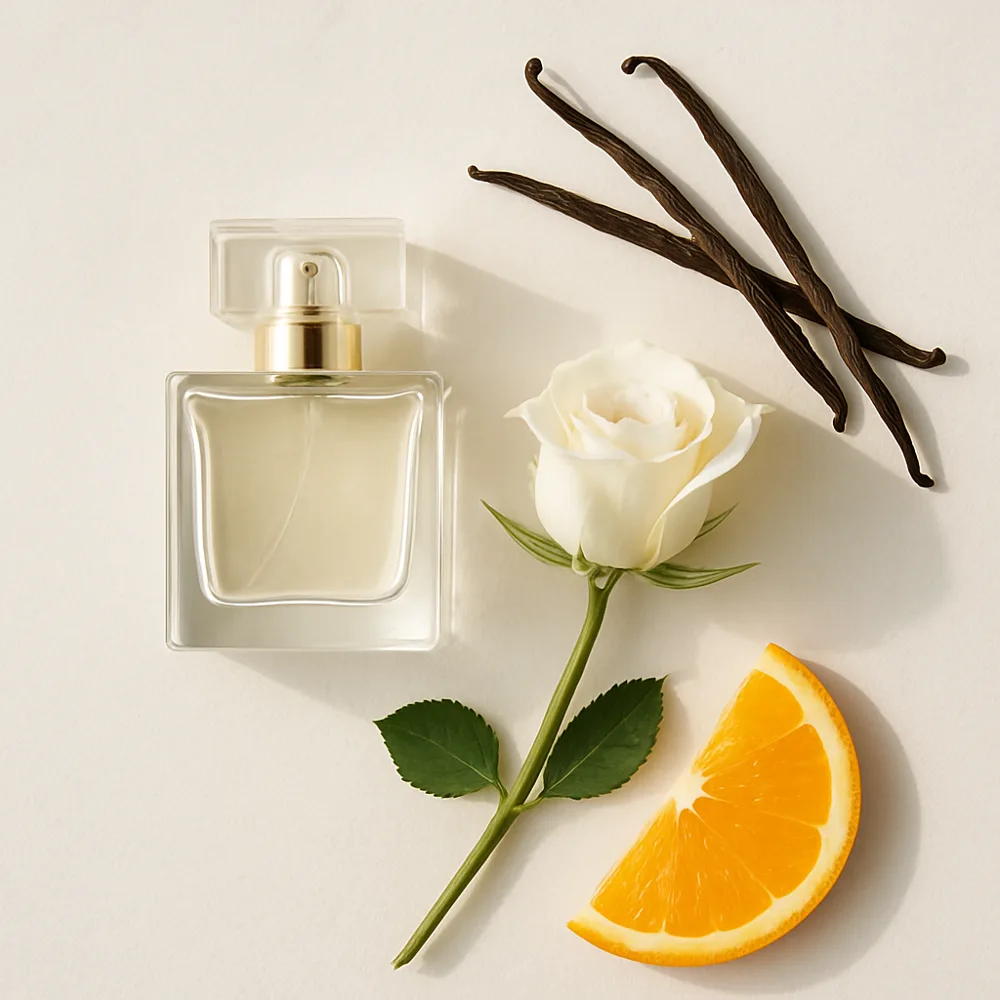
Musk is a broad fragrance term that can describe many effects. In modern perfumery, musky materials are often used to create softness, a clean impression, or a smooth foundation. Some musk accords suggest freshly washed fabric; others feel warm, powdery, or close to skin. The word does not point to one uniform scent, and a perfume can use musk without smelling obviously musky.
Musks frequently support other notes, helping a fragrance feel rounded and connected. They may soften a bright citrus opening, give a floral a gentle finish, or lend a smooth texture to woods. People can also perceive musky scents differently. One person may notice a clean, airy quality, while another focuses on warmth or sweetness, so trying a sample is especially useful.
If you are exploring musk, pay attention to the overall sensation rather than expecting a specific smell. Does the fragrance feel crisp, cozy, powdery, or quietly sensual to you? Try it on skin and check it again later, since musky notes can become more apparent as a perfume settles. For close settings, a modest application can preserve the subtle effect without overwhelming the people around you.
Why Some People Can Barely Smell Musk
One of the more surprising things about musk is that a noticeable share of people struggle to detect certain musk molecules at all. This is often called specific anosmia: a person can have a perfectly good sense of smell in general while being partly or completely insensitive to one particular material. Because modern perfumes often rely on several different synthetic musks, someone who misses one may still pick up another, which helps explain why two people can describe the same fragrance so differently. If a musk-forward scent seems to vanish on you within minutes, it may not have faded at all; you may simply be less sensitive to that material than the people around you.
This matters when you decide how much to apply. Adding more sprays to chase a note you cannot perceive can leave a perfume much stronger for others than it is for you. Asking a trusted friend for an honest opinion, or smelling a sprayed paper strip after it has rested for a while, can give you a better sense of how a musky fragrance actually projects.
A brief note on where musk comes from
Historically, musk came from an animal source, a gland of the male musk deer. That practice raised serious ethical and conservation concerns, and today perfumery relies almost entirely on synthetic musks developed in laboratories over the past century or so, along with some plant materials such as ambrette seed, which has a naturally musky character. Synthetic musks fall into several chemical groups, and each brings its own nuance: some feel bright and laundry-clean, others denser, warmer, or faintly fruity. This variety is one reason the word covers such a wide range of effects.
Getting to know musk through comparison
A useful way to train your nose is to sample two or three fragrances side by side and focus only on the drydown, the stage several hours in when most top and heart notes have faded. Musk usually shows itself most clearly here. Our guide on how to sample perfume without rushing offers practical ways to space out those tests, and learning how to read a perfume's notes can help you spot musk in a listing even when it sits quietly in the base. Over time, you may find you prefer one musk style consistently, which makes choosing your next scent much easier.