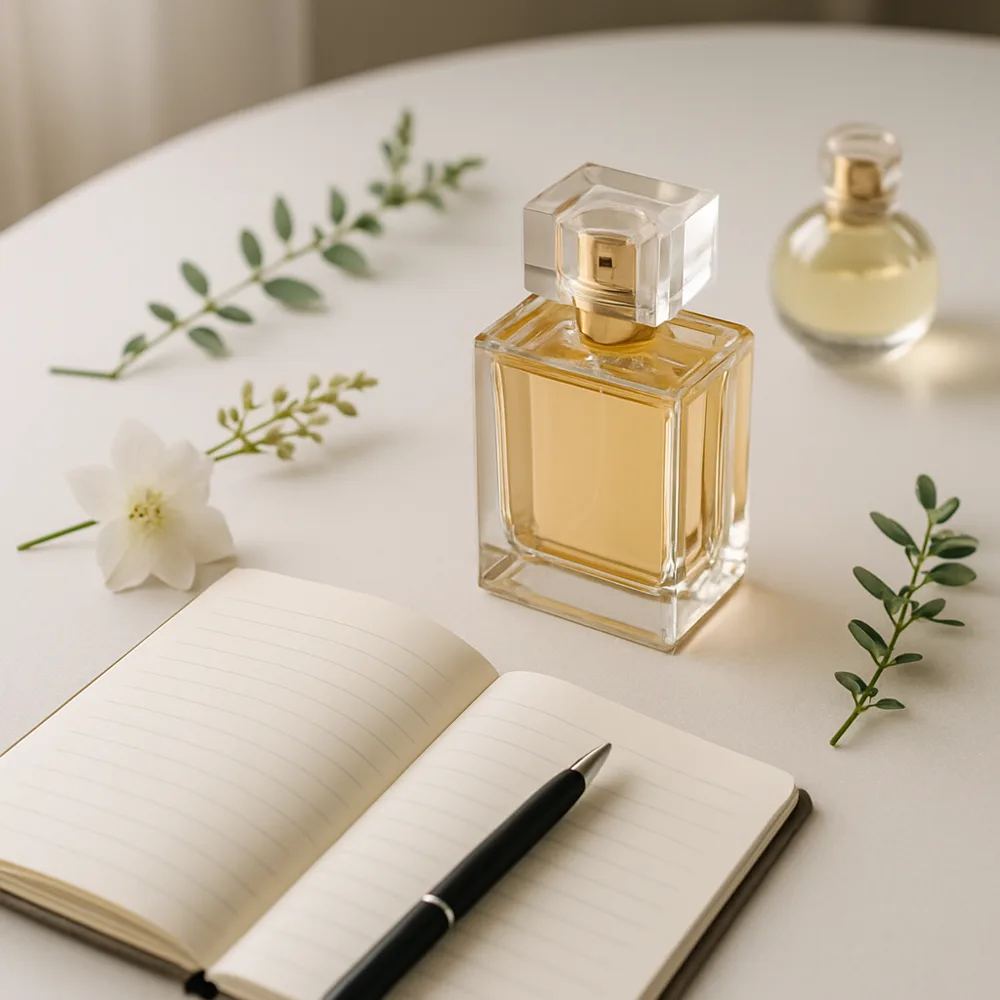
Drydown is the stage of a fragrance you notice after its opening has softened. Many perfumes begin with bright or volatile impressions that are easy to smell soon after application. Over time, the fragrance may seem warmer, smoother, woodier, or more closely blended. The term describes an evolving impression, not a moment when the perfume becomes completely dry.
People often pay attention to drydown because it reveals whether they enjoy wearing the fragrance beyond its first burst. A sparkling opening may be appealing in a quick sniff, while a sweet or powdery base may become more prominent later. The reverse can happen too: a perfume that starts rich may settle into a softer skin scent. Formula, application, skin, and surroundings all influence what you notice.
To evaluate a drydown, apply a small amount to skin and check it after the opening has passed. Try to avoid making a final decision from a single quick spray in the air. You can write down how the scent feels at different points without relying on exact timing. If the later impression is the part you enjoy most, that is a meaningful reason to keep exploring the fragrance.
Reading the Drydown: What to Notice and Why It Matters
Because the drydown is the part of a fragrance you live with longest, it helps to know which materials usually shape it. Base notes tend to be heavier, slower-evaporating ingredients: woods such as cedar and sandalwood, resins like benzoin and labdanum, vanilla, tonka, patchouli, vetiver, ambery accords and musks. If a perfume's listed notes lean heavily on these, you can expect a fuller, longer-lasting later stage. Our guide on how to read a perfume's notes explains how these lists are usually organised, though they describe an impression rather than an exact formula.
It is also worth remembering that the stages overlap. Perfumers rarely build a fragrance as three separate layers that switch on and off. Instead, the brighter materials fade gradually while the deeper ones become easier to notice. Some modern fragrances are deliberately linear, meaning the drydown smells much like the opening, while others change character dramatically.
Questions to ask yourself
- Has the character changed? Note whether it feels sweeter, drier, creamier, earthier or more powdery than the start.
- How close does it sit? Many drydowns become quieter, staying near the skin rather than projecting around you.
- Is anything unexpected appearing? Musks and ambery materials can surface late and surprise you.
- Would you be happy smelling this for hours? This is often the most practical test of all.
Concentration and skin
The concentration of a fragrance can affect how its drydown feels. Richer formats often carry base materials with more presence, though this varies between brands and formulas; see eau de parfum vs eau de toilette for more on the differences. Skin also plays a part: some people find that certain musks almost vanish on them, while others notice them strongly. Testing on your own skin, ideally over a relaxed day, gives a far more honest picture than a paper strip, and our advice on sampling perfume without rushing can help you plan those tests.